
Валенки да валенки,
Ой, да не подшиты стареньки,
Нельзя валенки носить,
Не в чем к миленькой сходить.
Валенки, валенки,
Эх, не подшиты стареньки,
Валенки да валенки,
Эх, не подшиты стареньки.
Ой, да не подшиты стареньки,
Нельзя валенки носить,
Не в чем к миленькой сходить.
Валенки, валенки,
Эх, не подшиты стареньки,
Валенки да валенки,
Эх, не подшиты стареньки.
How Alzheimer's cafe helps people
to remember
they are human
to remember
they are human
Living with dementia or Alzheimer's diseaseㅤㅤmeans being isolated from society and the rest of the world – it is safer that way since in these diseases, people lose their memory and lose the ability to think clearly. However, isolation is not a solution: people with this disease also have the right to a happy life, but neither society nor the urban environment is ready for it. For example, according to recent surveys, only 68% of Russians know what dementia is and how it manifests itself. This is why the Alzheimer's Café Nezabudka works: here people
with dementia and their relatives can feel needed and, strange as it may sound, normal again. We attended a meeting of the club and now tell its story.
with dementia and their relatives can feel needed and, strange as it may sound, normal again. We attended a meeting of the club and now tell its story.
Dementia is an intellectual impairment. If a person was lecturing and now cannot string two words together - this is a symptom. If a person was collected and now puts the phone in the freezer - this is a symptom. Dementia and Alzheimer's disease aren't equal. The last one is an independent disease that leads to the destruction of neurons. The development of dementia can be caused by vascular pathologies, and Alzheimer's disease is always associated with hereditary predisposition and neurological changes.


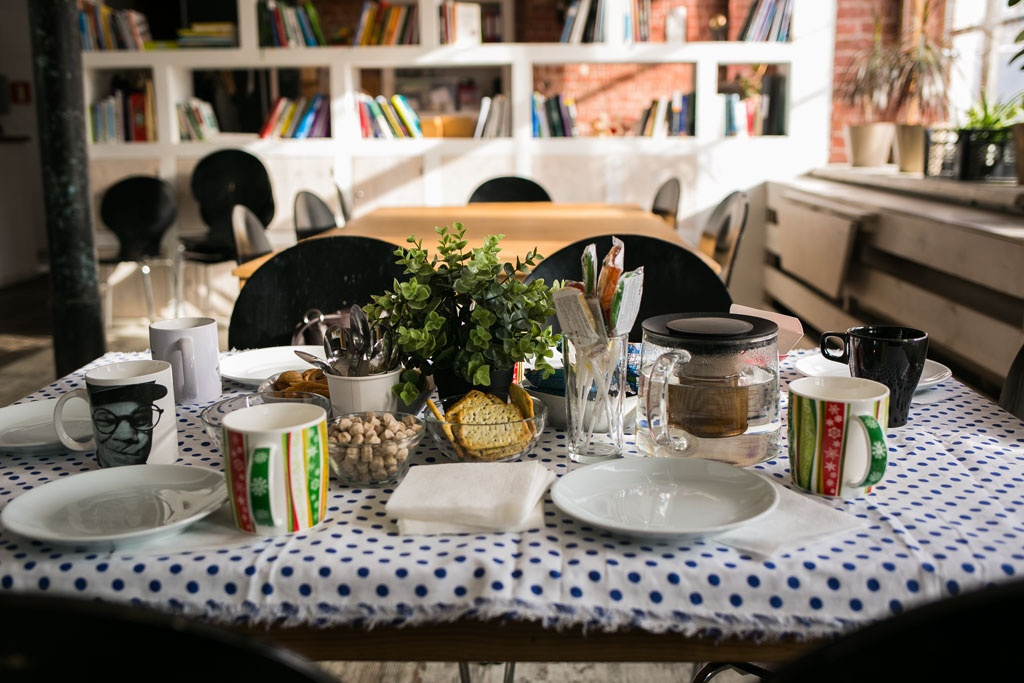
Small room in the centre of Moscow. Women put bowls of sweets, soufflés, marmalades and grapes on the table. There are 4 tables with 8 seats each. The middle of the hall is empty. A woman in an orange t-shirt moves quickly from corner to corner. While she's running back and forth, it's like she's filling up all the space in here. 'Where are the guests? Where are my guests?!', she's saying to herself, sometimes turning to those around her. It's a bit like preparing for a dinner party. In five minutes, the Alzheimer's cafe Club Nezabudka will open here. Guests who come today share the same fate — this is a gathering place for people with dementia and their relatives.

Aleksandra Shchetkina
president of Altcrus
president of Altcrus
Two years ago my aunt was diagnosed with Alzheimer’s disease.
I know more than a hundred charitable foundations dealing with ecology, animals, and helping people with various problems, but could not find anything to help my aunt. I’ve been working in non-profit organizations for over sixteen years, so decided to create a charity project and help others who faced the same problem. I found an autonomous non-profit organization called Altsrus and contacted its head, a doctor Maria Gantman. We became friends, and since last years I have been the head of Alcrus [Gantman now works as a vice-president].
Our foundation is a member of the International Association of Alzheimer’s Organizations. There are more than sixty members from around the world — Australia, Chile, Argentina, Ireland and the USA. A couple of years ago, I was on a training course for members of this association in Washington, D.C. I met colleagues from different organizations and learned about the Alzheimer’s Café project. For more than twenty-five years this practice has been widespread in the USA and Europe, but in Russia there was no such thing. I spent a long time preparing, learning about the format, consulting with colleagues, collecting statistics.
Couple years ago, I joined the "More than Employment" internship from Impact Hub Moscow. It involved NGOs in helping elderly people. As part of the internship, I had to develop a project. I remembered the idea of an alzheimer’s cafe and decided to make a club called Nezabudka.ㅤ ㅤThat's defenitely a club, because elderly people remember village clubs, meeting clubs in the Soviet Union.
And I thought that this format would be pleasant for our guests.
I know more than a hundred charitable foundations dealing with ecology, animals, and helping people with various problems, but could not find anything to help my aunt. I’ve been working in non-profit organizations for over sixteen years, so decided to create a charity project and help others who faced the same problem. I found an autonomous non-profit organization called Altsrus and contacted its head, a doctor Maria Gantman. We became friends, and since last years I have been the head of Alcrus [Gantman now works as a vice-president].
Our foundation is a member of the International Association of Alzheimer’s Organizations. There are more than sixty members from around the world — Australia, Chile, Argentina, Ireland and the USA. A couple of years ago, I was on a training course for members of this association in Washington, D.C. I met colleagues from different organizations and learned about the Alzheimer’s Café project. For more than twenty-five years this practice has been widespread in the USA and Europe, but in Russia there was no such thing. I spent a long time preparing, learning about the format, consulting with colleagues, collecting statistics.
Couple years ago, I joined the "More than Employment" internship from Impact Hub Moscow. It involved NGOs in helping elderly people. As part of the internship, I had to develop a project. I remembered the idea of an alzheimer’s cafe and decided to make a club called Nezabudka.ㅤ ㅤThat's defenitely a club, because elderly people remember village clubs, meeting clubs in the Soviet Union.
And I thought that this format would be pleasant for our guests.
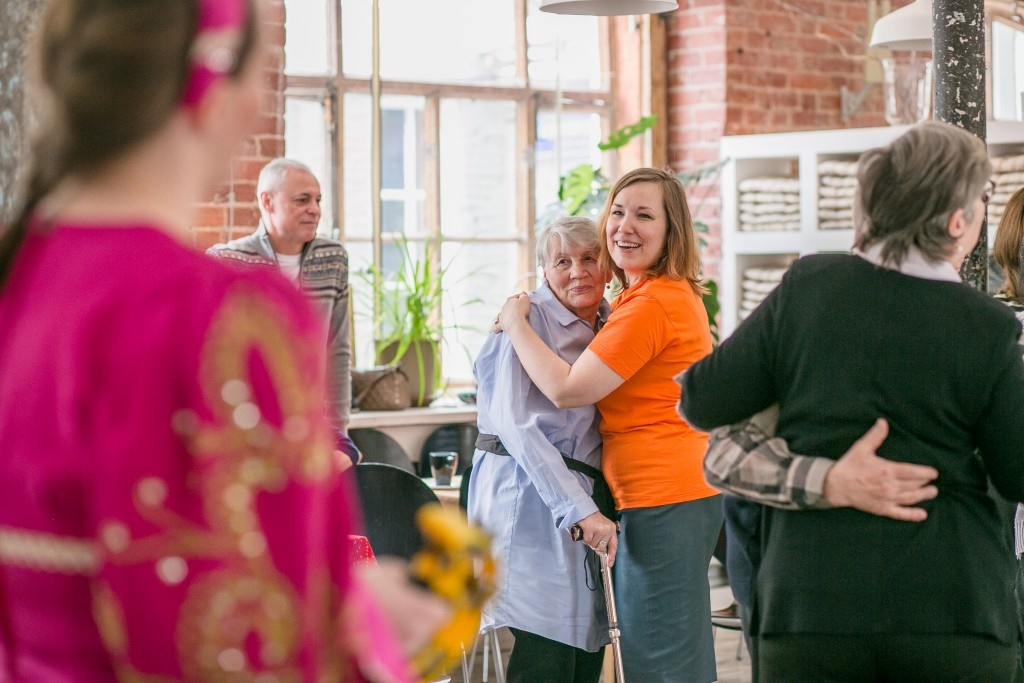
The program for that evening includes tea, crafts and dancing. All this is free of charge. The costs of renting the premises and materials are paid from donations to the Altsrus Foundation. Alexandra Shchetkina, the one in the orange T-shirt, welcomes the first guests. She is the director of the club and this is not her first meeting. She knows many of the visitors by sight. Alexandra stands at the entrance and helps the grandparents take off their outerwear and gives them a hug. 'Shall we dance tonight?', — she addresses one of the old ladies. The granny nods approvingly, though she limps a little. Old ladies came here like on holiday — all in dresses, powdered.
One of the rules of the club isn't to talk about the disease. It's forbidden — here people with dementia forget about their diagnosis for a while, and relatives have a rest from the daily routine. Elderly grandparents may quickly forget where they are or ask the same thing several times in a row. The team of volunteers here know how to respond to this. In reality, this puts people with dementia in a position of perpetual isolation: they either live in special boarding houses or at home with caregivers. People with dementia do not go outside. They may forget where they are and how to get back in.
One of the rules of the club isn't to talk about the disease. It's forbidden — here people with dementia forget about their diagnosis for a while, and relatives have a rest from the daily routine. Elderly grandparents may quickly forget where they are or ask the same thing several times in a row. The team of volunteers here know how to respond to this. In reality, this puts people with dementia in a position of perpetual isolation: they either live in special boarding houses or at home with caregivers. People with dementia do not go outside. They may forget where they are and how to get back in.

Aleksandra Shchetkina
president of Altcrus
president of Altcrus
The meeting itself is a three-hour family monthly event. People come there with their elderly relatives with dementia. They sit in a café, socialize and drink tea. There may also be performances by doctors, songs and dances, and workshops. The aim is free communication, which helps people with dementia to get back into society. As they are always at home or in boarding houses, here they go out with their family. For the relatives of an elderly person with Alzheimer's disease, the café helps them to feel freedom, comfort and security.
We bring bouquets of wildflowers. We already have a special playlist of three hundred songs from the 1930s through the 1970s. We don't even have to know any moves: we just hug, move around the hall. And the main thing is communication: funny jokes, memories, involvement of relatives.
To get the guests talking, we start with neutral topics, ask them if they like it here, find out about something from their past life that they remember well. One grandmother told how with girls in the village they used to sing songs and play the accordion, and you realize that it was in the 30s of the last century. And someone was the head of a factory... And you get carried away, and visitors see that the eyes of the interlocutors are burning.
We bring bouquets of wildflowers. We already have a special playlist of three hundred songs from the 1930s through the 1970s. We don't even have to know any moves: we just hug, move around the hall. And the main thing is communication: funny jokes, memories, involvement of relatives.
To get the guests talking, we start with neutral topics, ask them if they like it here, find out about something from their past life that they remember well. One grandmother told how with girls in the village they used to sing songs and play the accordion, and you realize that it was in the 30s of the last century. And someone was the head of a factory... And you get carried away, and visitors see that the eyes of the interlocutors are burning.
Thirty-five minutes after it starts. All four tables are occupied by people. Behind one of them, a woman is humming some kind of tune. Her eyes are staring somewhere in the opposite window. She's humming the melody of 'Valenki'. 'I used to sing it, but now I've forgotten the words,' she says. At other tables they pour tea into glasses and exchange short remarks: 'Is everything all right? Are you enjoying it? Do you want a cookie?' People with dementia have difficulty understanding complex phrases.
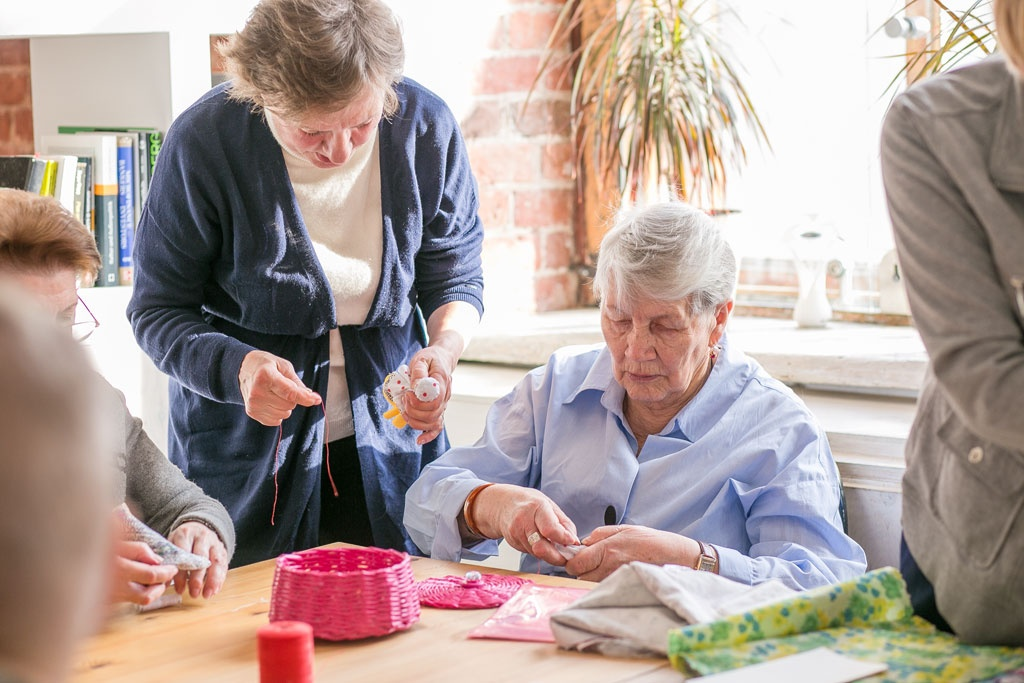
After a while, volunteers bring visitors materials for crafts. Today in Nezabudka they will make a bouquet of artificial spruce branches. At one of the tables, daughter and her grandfather divided their duties: she holds a stick with needles, and he ties them. It is important for people with dementia to feel needed, even if their range of activities is small. Someone has already managed this task. One grandmother in a purple suit inhales the scent of her plastic bouquet and confidently asserts, 'Ooh, it smells like a forest!'. 'Did you make this? You're taking it home!', her tablemates tell her.
In the meantime, the musicians were preparing in a small closed room — today there will be live music in the cafe. They admit that their audience is just such old people — they perform for them for free. 'This is their chance to feel happy again,' says the singer. Soon Nezabudka will start dancing.
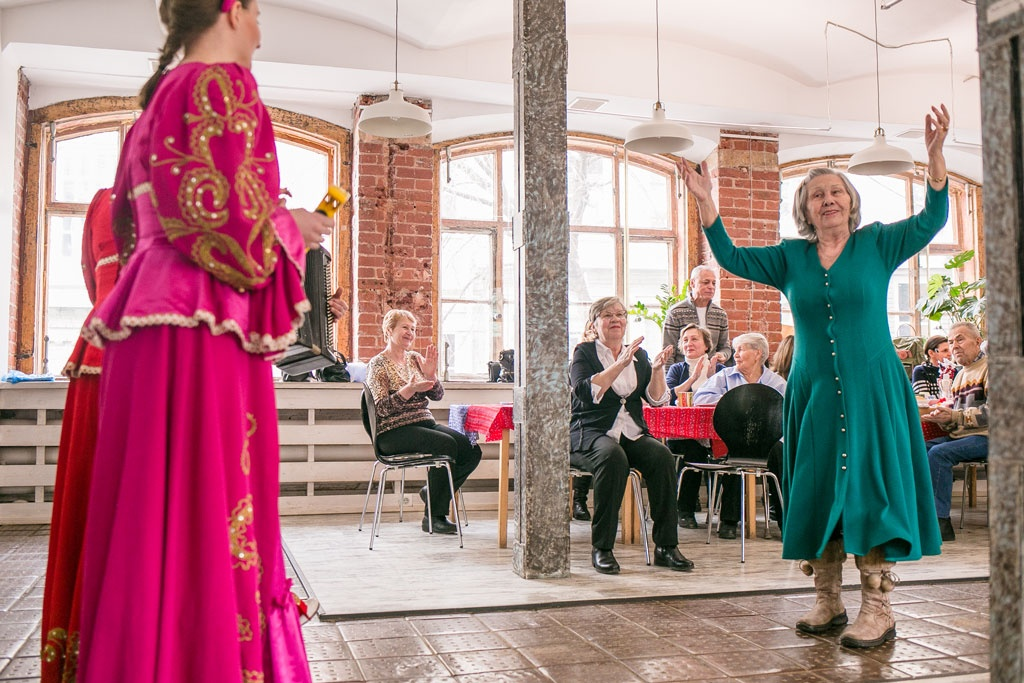
The accordion begins to play. The cafe seems to have turned into a village club. People around cheerfully get up from their tables and gather in a circle in the center of the room. The organizer brings an elderly man to him: 'I've brought you a gentleman'. The grandmothers turned out to be perky. They quickly incorporated the old man into their society. Volunteers remained at some of the tables — they watch people with dementia.
After a while, volunteers bring visitors materials for crafts. Today in Nezabudka they will make a bouquet of artificial spruce branches. At one of the tables, daughter and her grandfather divided their duties: she holds a stick with needles, and he ties them. It is important for people with dementia to feel needed, even if their range of activities is small. Someone has already managed this task. One grandmother in a purple suit inhales the scent of her plastic bouquet and confidently asserts, 'Ooh, it smells like a forest!'. 'Did you make this? You're taking it home!', her tablemates tell her.
In the meantime, the musicians were preparing in a small closed room — today there will be live music in the cafe. They admit that their audience is just such old people — they perform for them for free. 'This is their chance to feel happy again,' says the singer. Soon Nezabudka will start dancing.
The accordion begins to play. The cafe seems to have turned into a village club. People around cheerfully get up from their tables and gather in a circle in the center of the room. The organizer brings an elderly man to him: 'I've brought you a gentleman'. The grandmothers turned out to be perky. They quickly incorporated the old man into their society. Volunteers remained at some of the tables — they watch people with dementia.

Aleksandra Shchetkina
president of Altcrus
president of Altcrus
Our guests are really interesting people with their own individuality. I tell one story for example. The guest's name is Anna Mikhailovna, she is ninety years old. When she came for the second time, she recognized me. It is so valuable that a person remembers you despite the illness. At the last cafe she and I baked pies, the guests rolled out the dough, put the filling on, and put the pies in the oven. At first Anna Mikhailovna sat down at the table and said that she didn't have the slightest desire to do anything. Five minutes later grandmother was already all in the dough, clapping. When we baked the pies and put them on the table, she was very surprised: 'Oh, baking!' And when we told her who did it, she was so happy: 'Oh, no, me? How wonderful!'
If my aunt were alive, the first thing I'd do would be to take her there. She was so fond of lounging and dancing, she would have loved it. We even have a guest whose name is the same as my aunt's — Lydia Vasilyevna — and it's worth a lot to see her in high spirits.
If my aunt were alive, the first thing I'd do would be to take her there. She was so fond of lounging and dancing, she would have loved it. We even have a guest whose name is the same as my aunt's — Lydia Vasilyevna — and it's worth a lot to see her in high spirits.
There's a little a kind of dimple on the dance floor. One of the grannies had already unsuccessfully hit it with her foot. She squinted her eyes questioningly, looked around and headed off to dance with her friends next. People with dementia can instantly forget such moments in life.
In addition to the volunteers, relatives of grandparents sit at the tables. One of them sits and looks at her mother. With every movement she makes, the corners of the girl's lips rise and a blush appears on her cheeks. Sometimes it's as if the grandmother freezes, gets lost, moves her hands around her head, and then starts dancing again. It's Aunt Marina who lights up. She literally drowns herself in songs about Moscow. She closes her eyes and raises her head upwards, as if imagining something.
Her daughter Nastya says that her mom can't hear well, but she loves to move. It makes the old lady smile. After dancing, Aunt Marina sits down at the table and greedily nibbles grapes. 'I've never heard that I'm a good dancer. How did say this? It's just fine, nothing special!', she replies to a compliment from her tablemate, already unwrapping a candy. On the table next to her is a mug of tea, the last one for the day. Her daughter is already ordering a cab. In five minutes, the other guests will be leaving Nezabudka. The next meeting is due in a month.
In addition to the volunteers, relatives of grandparents sit at the tables. One of them sits and looks at her mother. With every movement she makes, the corners of the girl's lips rise and a blush appears on her cheeks. Sometimes it's as if the grandmother freezes, gets lost, moves her hands around her head, and then starts dancing again. It's Aunt Marina who lights up. She literally drowns herself in songs about Moscow. She closes her eyes and raises her head upwards, as if imagining something.
Her daughter Nastya says that her mom can't hear well, but she loves to move. It makes the old lady smile. After dancing, Aunt Marina sits down at the table and greedily nibbles grapes. 'I've never heard that I'm a good dancer. How did say this? It's just fine, nothing special!', she replies to a compliment from her tablemate, already unwrapping a candy. On the table next to her is a mug of tea, the last one for the day. Her daughter is already ordering a cab. In five minutes, the other guests will be leaving Nezabudka. The next meeting is due in a month.

There is an opinion of neurologist Vladimir Parfenov on how to diagnose Alzheimer and what is the current situation with this disease in Russia. We've paraphrased his speech.
When a patient comes to the doctor for the first time and complains about memory lapses, we use a test with memorization of 10-12 words. If he makes a mistake, we start prompting him. Let's say we asked him to remember five words: 'grasshopper' - 'truck' - 'saucer' - 'lemonade' - 'theater'. If the patient forgets the word 'grasshopper', the doctor asks: did we have any insect? If the clues help, this may be a variant of the norm. But for a patient with Alzheimer's disease, the semantic clue doesn't work. For him, grasshopper, ant, cockroach — it's all the same. He usually won't remember the word after a few minutes. After this testing, the degree of dementia or its absence becomes clear.
However, Alzheimer's disease is very rarely diagnosed in Russia. Last year, neurologists registered it in less than 10 000 cases. Most often Russian patients with incipient dementia are diagnosed with vascular pathology of the brain. Doctors think that dementia is caused by blood vessels — atherosclerosis, hypertension. Yeah, those are factors, but they're not the main ones. 'Vascular' are responsible for about 15-20% of dementia cases. In order to diagnose 'vascular dementia' it is necessary to do an MRI of the head.
Russian doctors simply do not know Alzheimer well, and the correct diagnosis is rarely made. Usually psychiatrists make this diagnosis, but at the very last stage, when a person has dementia and we are talking about his or her capacity. And in general in our country, according to different calculations, instead of 10 000, there are 1 500 000 patients with Alzheimer.
When a patient comes to the doctor for the first time and complains about memory lapses, we use a test with memorization of 10-12 words. If he makes a mistake, we start prompting him. Let's say we asked him to remember five words: 'grasshopper' - 'truck' - 'saucer' - 'lemonade' - 'theater'. If the patient forgets the word 'grasshopper', the doctor asks: did we have any insect? If the clues help, this may be a variant of the norm. But for a patient with Alzheimer's disease, the semantic clue doesn't work. For him, grasshopper, ant, cockroach — it's all the same. He usually won't remember the word after a few minutes. After this testing, the degree of dementia or its absence becomes clear.
However, Alzheimer's disease is very rarely diagnosed in Russia. Last year, neurologists registered it in less than 10 000 cases. Most often Russian patients with incipient dementia are diagnosed with vascular pathology of the brain. Doctors think that dementia is caused by blood vessels — atherosclerosis, hypertension. Yeah, those are factors, but they're not the main ones. 'Vascular' are responsible for about 15-20% of dementia cases. In order to diagnose 'vascular dementia' it is necessary to do an MRI of the head.
Russian doctors simply do not know Alzheimer well, and the correct diagnosis is rarely made. Usually psychiatrists make this diagnosis, but at the very last stage, when a person has dementia and we are talking about his or her capacity. And in general in our country, according to different calculations, instead of 10 000, there are 1 500 000 patients with Alzheimer.
Vladimir Parfenov
neurologist, professor
of First Moscow State
Medical University
neurologist, professor
of First Moscow State
Medical University
'Nezabudka' is the translation for the English 'forget-me-not'. This flower is the unspoken symbol of Alzheimer's disease
You should see a neurologist if a person:
- forgets recent events;
- frequently asks questions;
- puts things in unfamiliar places;
- gets lost in familiar surroundings;
- makes mistakes in monetary calculations;
- has no sense of time;
- accuses loved ones of stealing, shows aggression or, on the contrary, apathy;
- confuses and forgets words, repeats himself;
- fails to cope with tasks that he or she used to solve easily.
If you or your relative has been diagnosed with dementia
or Alzheimer's disease, you can contact Alcrus in Russia. You can also help the organization's specialists
by supporting them financially.
or Alzheimer's disease, you can contact Alcrus in Russia. You can also help the organization's specialists
by supporting them financially.
Nikita Ilin
Elizabeth Obolkina
Daniil Babkin
Elizabeth Obolkina
Daniil Babkin
Project team
